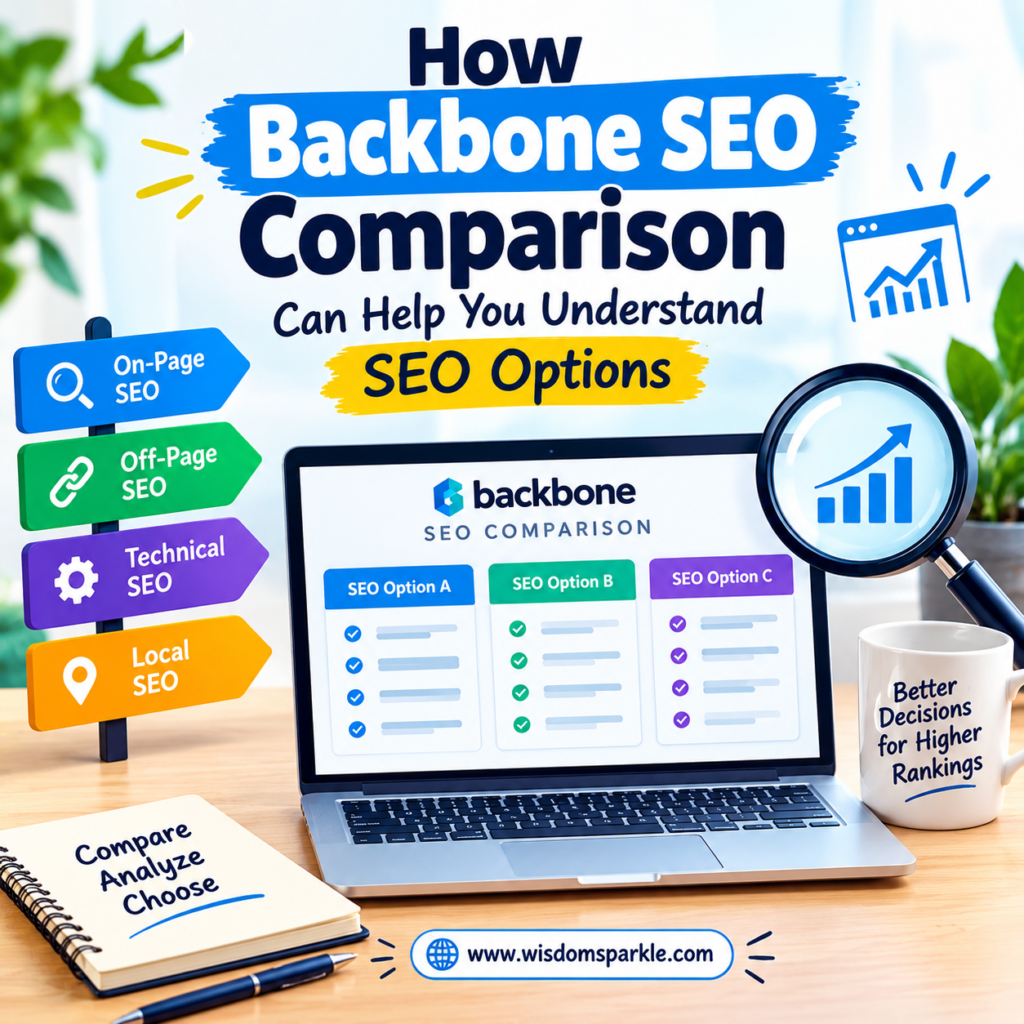
How Backbone SEO Comparison Can Help You Understand SEO Options
 Shruti Thakral
October 8, 2026
SEO can feel confusing when you are just starting. There are many tools, methods, services, and strategies to choose from. Each one may promise better rankings, more traffic, or a stronger online presence.
This is where a backbone SEO comparison can be helpful. It gives you a simple way to look at different SEO options and understand what each one offers.
You do not need to be an SEO expert to compare your options. You just need to know what your website needs and what you want to achieve.
In this guide, we will look at SEO options in a simple way and understand what you should check before making a choice.
What Does SEO Mean?
SEO stands for Search Engine Optimization.
It is the process of improving a website so that search engines can understand its pages and show them to people searching for related information.
For example, imagine you have a website about healthy food. You publish an article about healthy breakfast ideas.
When someone searches for “easy healthy breakfast ideas,” you want your article to have a chance of appearing in search results.
SEO can help improve that chance.
SEO includes many different areas. These can include website structure, content, keywords, page speed, links, images, and other website factors.
Why Are SEO Options So Different?
There is no single SEO method that works for every website.
A small blog may have different needs from a large online store. A local business may need a different approach from a news website.
Some websites may need better technical SEO. Others may need more useful content or stronger backlinks.
This is why comparing different SEO options can be useful.
Instead of choosing something just because it is popular, you can look at what it actually offers.
What Is a Backbone SEO Comparison?
A backbone SEO comparison can be thought of as a simple way to compare the main parts of different SEO options.
The word “backbone” refers to the basic support behind something.
In SEO, the backbone can include the important areas that help a website perform well in search.
These areas may include:
- Technical SEO
- On-page SEO
- Keyword research
- Content
- Website structure
- Internal links
- Backlinks
- Page speed
- Mobile experience
- SEO tracking
Looking at these areas can help you understand whether an SEO option is suitable for your website.
Why Should You Compare SEO Options?
Choosing an SEO tool or service without checking it carefully can lead to wasted time and money.
Different tools can have different features. Some may focus mainly on keywords. Others may provide website audits, backlink information, competitor research, or rank tracking.
SEO services can also be very different.
One company may focus on content. Another may focus on technical improvements. Someone else may mainly build backlinks.
A comparison helps you understand these differences before you decide.
Start With Your Website Goals
Before comparing SEO options, think about what you actually want.
Do you want more visitors?
Do you want your blog posts to rank higher?
Do you want more local customers?
Do you want to improve your website structure?
Do you want to find technical problems?
Your goal should guide your choice.
For example, if your main goal is content growth, you may need tools that help with keyword research and content planning.
If your website has technical problems, an SEO audit tool may be more useful.
Technical SEO Matters
Technical SEO is one of the basic parts of a website’s SEO.
It helps search engines crawl and understand your website.
Technical SEO can include things such as:
- Website speed
- Mobile usability
- Indexing
- Sitemaps
- Robots.txt
- Canonical URLs
- Broken links
- Website security
- Page structure
You do not have to understand every technical detail.
But when comparing SEO options, it is useful to check whether they can help you find and fix important technical problems.
Content Is Another Important Part
Good SEO is not only about technical settings.
Your website also needs useful content.
Search engines want to provide people with helpful information. Your content should therefore answer the questions your readers are asking.
Good content should be easy to read and useful.
It should also be written for real people instead of being filled with keywords.
When doing a backbone SEO comparison, check whether an SEO option helps you understand your content and improve it.
Keywords Still Matter
Keywords are words and phrases that people type into search engines.
For example, someone searching for information about website speed might use phrases such as “how to improve website speed” or “website speed tips.”
Keyword research helps you understand what people are searching for.
A good SEO tool may help you find keywords, check search competition, and understand related topics.
However, keywords should be used naturally.
Adding the same keyword again and again can make an article difficult to read.
Internal Links Can Help Your Website
Internal links connect one page of your website to another page on the same website.
For example, a blog about healthy eating could link to another article about healthy breakfast foods.
These links can help visitors find more useful information.
They can also help search engines understand how different pages on your website are connected.
When comparing SEO options, see whether they help you find opportunities for internal linking.
Backlinks Are Also Part of SEO
Backlinks are links from other websites to your website.
They can help search engines understand that other websites are referring to your content.
However, not every backlink is useful.
A large number of poor-quality links is not necessarily better than a smaller number of relevant and trustworthy links.
This is why you should be careful when comparing SEO services that promise a large number of backlinks.
Focus on quality and relevance rather than just numbers.
Page Speed Should Not Be Ignored
People do not like waiting for slow websites.
A slow page can make it harder for visitors to enjoy your website.
Page speed is therefore another area worth checking when reviewing your SEO.
An SEO tool or service may help identify things that are slowing your pages down.
These problems can include large images, unnecessary scripts, poor hosting performance, or other technical issues.
Improving speed can create a better experience for visitors.
Mobile SEO Is Important
Many people use their phones to browse websites.
This means your website should work well on smaller screens.
Text should be easy to read. Buttons should be easy to use. Pages should load properly.
When comparing SEO options, check whether mobile performance is included.
A website that looks good on a computer but is difficult to use on a phone may lose visitors.
Look at SEO Reporting
SEO takes time.
You need a way to see whether your work is moving in the right direction.
Good reporting can help you understand things such as:
- Website traffic
- Keyword rankings
- Indexed pages
- Backlinks
- Technical problems
- Organic search performance
When comparing SEO tools or services, look at how clearly they show this information.
Reports should be simple enough for you to understand.
You should not need to be an SEO expert just to understand what happened to your website.
Free and Paid SEO Tools
There are both free and paid SEO tools.
Free tools can be useful for beginners and small websites.
Paid tools may offer more advanced features, larger databases, competitor information, or additional reports.
This does not mean a paid tool is always better.
The best option depends on your needs and budget.
Before paying for a tool, check what features you will actually use.
Do Not Choose an SEO Option Only Because It Is Popular
Popularity does not always mean something is right for your website.
A tool may be excellent but still not meet your needs.
For example, you may only need basic keyword research. Paying for a large SEO platform with many advanced features may not be necessary.
On the other hand, a growing business may need more detailed data and tracking.
Think about your own website first.
Compare Features That Actually Matter
When doing a backbone SEO comparison, avoid looking at too many features at once.
Focus on the things that matter to your website.
You can make a simple list like this:
SEO Area | What to Check |
Keywords | Research and tracking |
Content | Content improvement options |
Technical SEO | Website audits |
Backlinks | Link analysis |
Speed | Page performance |
Mobile | Mobile usability |
Reports | Easy-to-understand data |
Competitors | Competitor research |
This simple approach can make the decision easier.
Think About Your Budget
Your budget also matters.
SEO can be done in different ways.
You can learn SEO yourself, use SEO tools, hire a freelancer, or work with an SEO agency.
Each option has different costs.
If you have a small website, starting with basic tools and learning the fundamentals may be enough.
As your website grows, you can consider investing in more advanced tools or professional help.
Avoid Promises of Instant Rankings
Be careful with anyone who promises instant search rankings.
SEO usually takes time.
Search engines need to crawl, understand, and evaluate your website. Competition also affects how quickly you may see results.
A good SEO approach focuses on useful content, a healthy website, and steady improvement.
There is no magic button that guarantees a top position overnight.
How to Make a Simple SEO Comparison
You can follow a few simple steps.
First, write down your main SEO goal.
Second, identify the biggest problem with your website.
Third, find tools or services that can help with that problem.
Fourth, compare their important features.
Fifth, check the cost.
Finally, choose the option that fits your website instead of simply choosing the most expensive one.
This process can save both time and money.
Final Thoughts
Understanding SEO does not have to be difficult.
A backbone SEO comparison can help you look at different SEO options in a simple and organized way.
Instead of choosing a tool or service based only on advertising, look at what your website actually needs.
Check technical SEO, content, keywords, backlinks, page speed, mobile performance, and reporting.
Most importantly, remember that SEO is a long-term process.
You do not need to do everything at once. Start with the basics, fix the biggest problems, create useful content, and keep improving your website.
The right SEO option is not always the one with the most features. It is the one that helps you reach your goals in a practical and affordable way.