
Gym Abbreviations and Workout Terms Explained (DL, PR, EMOM, BW, AFAP, YGIG)
 Shruti Thakral
November 21, 2026
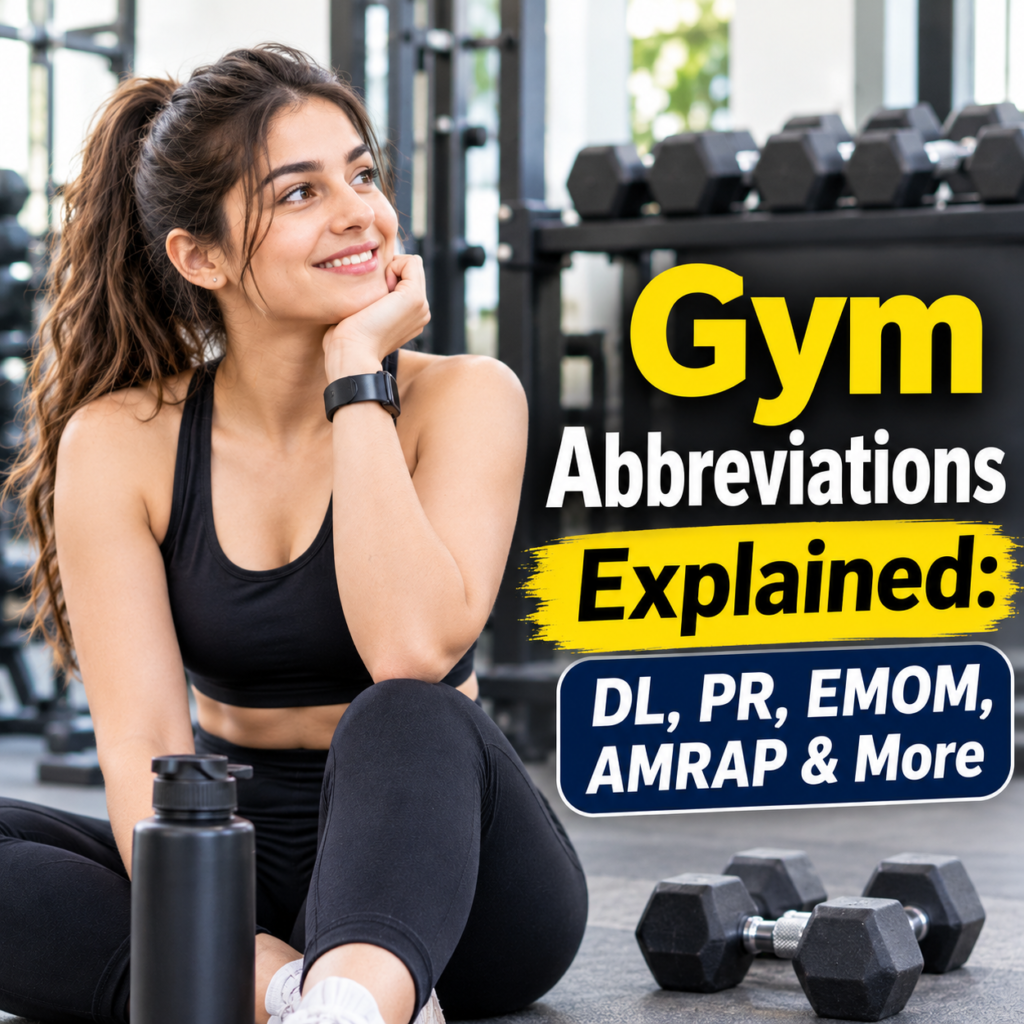
If you spend time at the gym, you’ll probably hear people using short forms like DL, PR, EMOM and BW. They can sound confusing when you’re just getting started. New to the basics? Start with our guide on what gym means.
Quick Reference: Common Gym Terms
| Term | Meaning |
|---|---|
| DL | Deadlift |
| PR | Personal Record |
| EMOM | Every Minute on the Minute |
| BW | Bodyweight |
| AFAP | As Fast As Possible |
| YGIG | You Go, I Go |
| AMRAP | As Many Rounds or Reps As Possible |
| WOD | Workout of the Day |
| HIIT | High-Intensity Interval Training |
| Rep | Repetition |
| Set | A group of repetitions |
| Superset | Two exercises performed back-to-back |
| 1RM | One-Rep Max |
| RPE | Rate of Perceived Exertion |
| Drop Set | Reducing weight and continuing an exercise |
Table of Contents
Common Abbreviations
These are short forms you’ll often come across in workout plans, gym conversations and fitness posts.
1. DL – Deadlift
DL stands for deadlift. It is a strength exercise where you lift a loaded barbell from the floor to hip level and then lower it back down.
Deadlifts work several muscle groups, including your glutes, hamstrings, back and core.
Example: Your trainer writes “DL – 3 sets of 8 reps” in your workout plan. This means you need to perform eight deadlifts, rest, and repeat for three sets.
If you want to understand the exercise better, read our guide on why every gym lover should make deadlifts part of their workout.
A quick safety reminder: Deadlifts need proper technique. Beginners should learn the movement with a qualified trainer before trying heavy weights.
2. PR – Personal Record
PR means personal record. It refers to your best performance in a particular exercise or activity.
It could be the heaviest weight you have lifted, the longest distance you have run, or your fastest time.
Example: Suppose you previously lifted 40 kg during a deadlift. Today, you manage 45 kg with good form. You have just set a new PR.
A PR doesn’t always mean lifting more weight. You can also set one by completing more repetitions or improving your running time.
3. BW – Bodyweight
BW stands for bodyweight. In workout plans, it often refers to exercises where you use your own body weight instead of adding dumbbells, barbells or other weights.
Example: If your workout says “BW squats – 3 sets of 12,” you need to perform 12 squats using your body weight, then repeat for three sets.
Push-ups, bodyweight squats and lunges are common examples.
There is another use worth knowing. In some strength programs, BW is used as a multiplier. For example, “squat 1.5 × BW” means lifting a total weight equal to 1.5 times your body weight.
If you want to exercise without gym equipment, try these beginner-friendly workout routines at home.
4. AFAP – As Fast As Possible
AFAP means as fast as possible. It tells you to complete a given exercise or workout in the shortest time you can while maintaining proper form.
Example: Your trainer asks you to complete 20 jumping jacks AFAP. You should finish them as quickly as you can without rushing so much that your movements become sloppy.
Speed is the goal, but good technique still matters.
5. YGIG – You Go, I Go
YGIG means You Go, I Go. It is a workout format where two people take turns completing exercises.
One person works while the other rests. Once the first person finishes, they switch.
Example:
- You and your friend decide to complete 20 squats each.
- You do your 20 squats while your friend rests.
- Your friend completes their 20 squats while you rest.
- You keep taking turns until you finish the planned rounds.
You may see this format in partner workouts and group fitness sessions.
Training Formats
These terms describe how a workout is arranged and how you should perform it.
6. EMOM – Every Minute on the Minute
EMOM stands for Every Minute on the Minute. It is a workout format where you start a set at the beginning of every minute.
Once you finish the required repetitions, you rest for the remaining time. When the next minute starts, you begin again.
Example: Your workout says:
- 10 squats every minute
- Continue for 10 minutes
If you finish 10 squats in 25 seconds, you get 35 seconds to rest. If you take 40 seconds, you get 20 seconds to rest.
The idea is to complete the assigned work within each minute.
7. AMRAP – As Many Rounds or Reps As Possible
AMRAP means As Many Rounds or Reps As Possible. You complete as many rounds or repetitions as you can within a set time.
Example: Your trainer gives you a 10-minute AMRAP:
- 10 squats
- 10 push-ups
- 10 jumping jacks
You keep repeating the circuit for 10 minutes. If you complete four full rounds and five squats from the next round, your score is four rounds plus five squats.
AMRAP workouts can be challenging, so choose a pace that lets you maintain good form.
8. WOD – Workout of the Day
WOD stands for Workout of the Day. It simply means the workout planned for that particular day.
You will often see this term in CrossFit classes and fitness communities.
Example: Your gym shares a WOD that includes squats, push-ups and a short run. Those exercises make up the workout for that day.
The exercises and difficulty can change from one day to another.
9. HIIT – High-Intensity Interval Training
HIIT stands for High-Intensity Interval Training. It involves short periods of challenging exercise followed by recovery periods.
For example, you might do 30 seconds of fast cycling and then take 30 seconds to pedal slowly or rest. You repeat these intervals for the planned duration.
Common HIIT exercises include:
- Jumping jacks
- High knees
- Burpees
- Fast cycling
- Sprint intervals
HIIT sessions can be demanding. You don’t need to push at maximum effort from the very first round.
Safety note: If you’re new to exercise or have a heart condition or other health concern, check with a healthcare professional before starting high-intensity workouts.
If you’re planning a routine that includes different types of exercise, see our guide on how to create a workout plan that fits your lifestyle.
Strength Terms
These terms come up when people discuss weights, repetitions and how difficult an exercise feels.
10. Rep – Repetition
A rep is one complete movement of an exercise.
For example, lowering your body into a squat and standing back up counts as one rep.
Example: If your trainer asks you to do 12 reps of squats, you need to complete the full squat movement 12 times.
11. Set
A set is a group of repetitions performed together before taking a rest.
Example: If your workout says “3 sets of 10 push-ups,” you do:
- 10 push-ups
- Take a rest
- 10 more push-ups
- Take another rest
- 10 final push-ups
That gives you three sets of 10 repetitions.
12. Superset
A superset means performing two exercises one after the other, usually with little or no rest between them.
Example: Your trainer pairs squats with lunges. You complete your squats and move straight to lunges. After both exercises, you take a rest.
Supersets can help save time and make a workout more challenging.
You can see how exercises are arranged in our guide to creating a leg day workout routine.
13. 1RM – One-Rep Max
1RM stands for One-Rep Max. It is the maximum weight you can lift for one complete repetition of an exercise while maintaining proper technique.
Example: If the heaviest weight you can deadlift for one good repetition is 60 kg, your deadlift 1RM is 60 kg.
Trainers sometimes use a percentage of your 1RM to plan workout weights. For example, 70% of a 60 kg 1RM is 42 kg.
Testing your 1RM can put a lot of demand on your body. Beginners should not attempt maximum lifts without guidance from a qualified trainer.
14. RPE – Rate of Perceived Exertion
RPE stands for Rate of Perceived Exertion. It describes how difficult an exercise feels to you.
In strength training, trainers often use a 1–10 scale. A higher number means the exercise feels harder.
| RPE | How it feels |
|---|---|
| 1–2 | Very easy |
| 3–4 | Easy |
| 5–6 | Moderate |
| 7–8 | Hard |
| 9 | Very hard |
| 10 | Maximum effort |
Example: If you finish a set of squats and feel you could comfortably do a few more repetitions, your effort may be around 7. If you feel you cannot complete another repetition with good form, your effort may be closer to 10.
Some trainers use a different RPE scale, such as 6–20. The numbers depend on which scale your trainer or workout plan follows.
15. Drop Set
A drop set is a strength-training technique where you reduce the weight after reaching fatigue or getting close to your limit, then continue the exercise with the lighter weight.
Example:
- You perform bicep curls with 10 kg dumbbells.
- Once you can no longer continue comfortably with good form, you switch to 7 kg dumbbells.
- You continue doing curls with the lighter weight.
Drop sets can make a workout more demanding. They are not necessary for every exercise or every beginner.
FAQs
1. What does DL mean in the gym?
DL stands for deadlift. It is a strength exercise where you lift a loaded barbell from the floor to hip level and lower it back down.
2. What does PR mean in a workout?
PR means personal record. It is your best performance in an exercise, such as your heaviest lift or fastest running time.
3. What does EMOM mean?
EMOM means Every Minute on the Minute. You begin the assigned exercise at the start of each minute and rest for whatever time remains after finishing the work.
4. What does BW mean in fitness?
BW means bodyweight. It can refer to exercises using your own body weight or, in some strength plans, be used as a multiplier for calculating a load.
5. What is the difference between AFAP and AMRAP?
AFAP means completing the assigned work as fast as possible. AMRAP means completing as many rounds or repetitions as possible within a set time.
6. What does YGIG mean in CrossFit?
YGIG means You Go, I Go. Two people take turns doing the workout while the other person rests.
7. What does WOD mean?
WOD stands for Workout of the Day. It refers to the exercise routine planned for that day.
8. What does RPE mean in weight training?
RPE means Rate of Perceived Exertion. It helps you describe how hard an exercise or set feels.
Final Note
Gym abbreviations become easier once you see them in real workout plans. You don’t have to memorise all these terms in one day.
Start with the basics, ask your trainer when something is unclear, and focus on learning the correct exercise technique. If you’re new to strength training, get guidance from a qualified trainer before attempting heavy lifts or demanding workout formats.





1 thought on “Gym Abbreviations and Workout Terms Explained (DL, PR, EMOM, BW, AFAP, YGIG)”
Comments are closed.