When people visit your website, they should be able to find what they are looking for quickly. The same is true for search engines like Google. If your website is well organized, both users and search engines can easily move from one page to another.
One of the best ways to make your website easy to use is by creating a flat site structure. This is a simple SEO strategy that helps important pages stay close to your homepage. It improves user experience, helps search engines crawl your website faster, and can even improve your search rankings.
In this blog, you’ll learn what a flat site structure is, why it matters, and how you can build one for your own website.
What Is a Flat Site Structure?
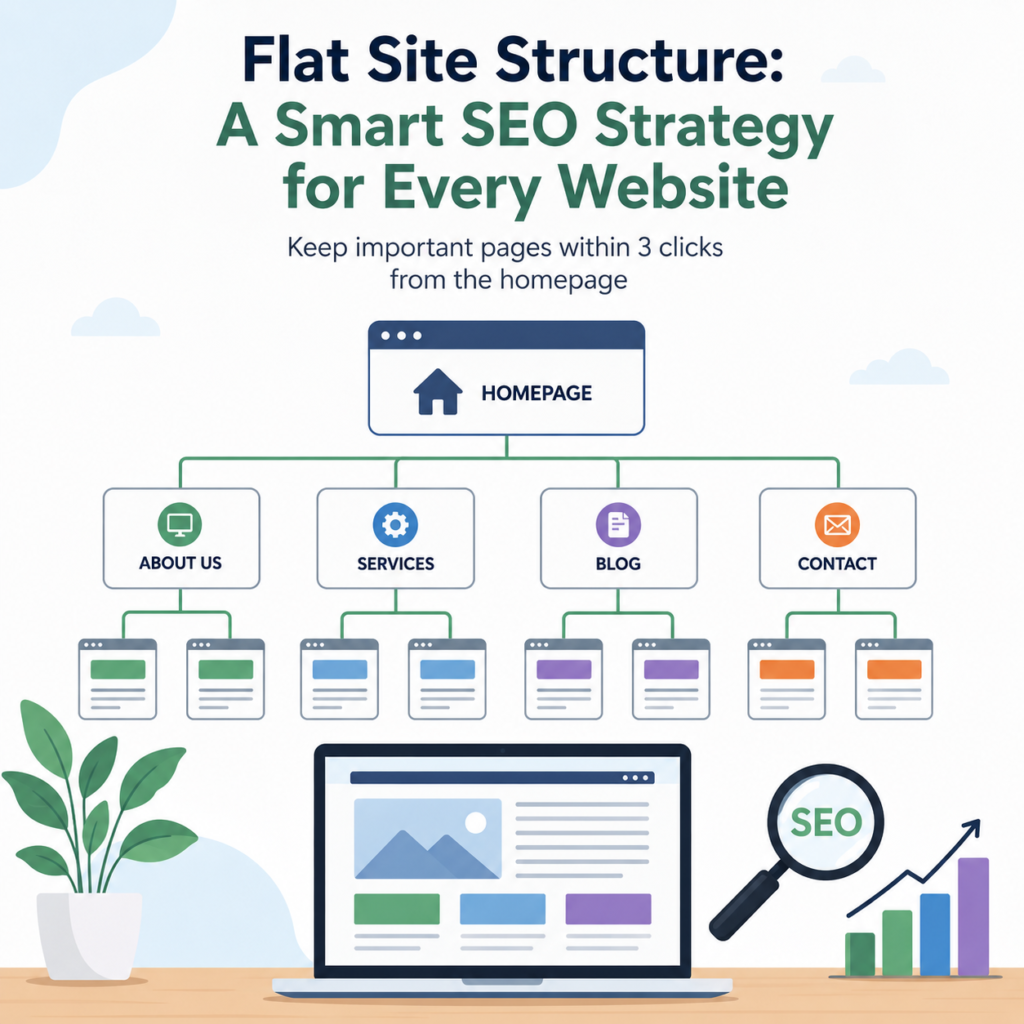
A flat site structure is a way of organizing your website so that visitors can reach important pages in just a few clicks. In most cases, your important pages should be no more than three clicks away from the homepage.
For example:
- Homepage
- Category Page
- Blog Post or Service Page
This simple structure makes it easy for visitors to find information without clicking through many different pages.
A website with too many levels is called a deep site structure. In a deep structure, users may have to click five or six times before reaching the page they need. This can make your website confusing and harder for search engines to crawl.
Why Is a Flat Site Structure Important?
A flat site structure offers many benefits for both your visitors and your SEO efforts.
Better User Experience
People like websites that are easy to navigate. If visitors can quickly find the information they need, they are more likely to stay longer and visit more pages.
Easy navigation also creates a better first impression and increases trust in your website.
Faster Crawling by Search Engines
Search engines use bots to crawl websites. These bots follow links from one page to another.
If your important pages are close to the homepage, search engine bots can discover and index them more quickly. This means your new pages may appear in search results faster.
Better SEO Performance
A well-organized website helps search engines understand the relationship between your pages.
This makes it easier for Google to identify your most valuable content, which can improve your rankings over time.
Stronger Internal Linking
A flat structure naturally encourages good internal linking.
When pages link to each other in a logical way, visitors spend more time exploring your website. Internal links also help pass SEO value from one page to another.
What Does a Flat Site Structure Look Like?
Here is a simple example.
Homepage
↓
Categories
- Services
- Blog
- About Us
- Contact
↓
Individual Pages
- SEO Services
- Website Design
- Blog Articles
- Service Details
Every important page is easy to reach without going through many unnecessary steps.
Signs Your Website Has a Deep Structure
Your website may need improvement if you notice these problems:
- Visitors need many clicks to reach important pages.
- Some pages are difficult to find.
- Search engines are not indexing new pages quickly.
- Navigation menus are confusing.
- Some pages receive very little traffic because they are buried deep inside the website.
If any of these sound familiar, it may be time to simplify your website structure.
How to Create a Flat Site Structure
The good news is that creating a flat site structure is not difficult. Here are some simple steps.
Plan Your Website Before Building It
Start by listing all your important pages.
Group similar pages into categories so everything has a clear place.
For example:
- Home
- About
- Services
- Blog
- Contact
Then place related pages under each category.
Keep Important Pages Close to the Homepage
Your main service pages, popular blog posts, and important information should be easy to access.
Try to keep these pages within three clicks from your homepage whenever possible.
Use Clear Navigation Menus
Your menu should be simple and easy to understand.
Avoid adding too many menu items.
Use short and meaningful names such as:
- Home
- Blog
- Services
- About
- Contact
Visitors should know exactly where each link will take them.
Add Internal Links
Link related pages together naturally.
For example, if you write a blog about technical SEO, you can link to another article about XML sitemaps or page speed.
Internal links help visitors discover more content while helping search engines crawl your website.
Create Category Pages
If you publish many blog posts, organize them into categories.
Examples include:
- SEO
- Health
- Beauty
- Food
- Technology
Category pages make your content easier to browse and reduce unnecessary click depth.
Remove Unnecessary Levels
Sometimes websites have extra folders or pages that are not needed.
Instead of:
Home → Blog → SEO → Technical SEO → Page Speed → Article
You can simplify it to:
Home → Blog → Article
Keeping the path shorter improves navigation.
Common Mistakes to Avoid
Many website owners accidentally create a complicated structure.
Here are some common mistakes:
- Creating too many categories.
- Using confusing navigation menus.
- Hiding important pages deep inside folders.
- Forgetting to add internal links.
- Leaving important pages out of the main navigation.
- Creating orphan pages that have no internal links.
Avoiding these mistakes will make your website easier to use.
How a Flat Site Structure Helps SEO
A flat site structure supports several important SEO factors.
It improves crawl efficiency because search engines can discover pages faster.
It helps distribute link value across your website through internal links.
It reduces the chance of important pages being ignored.
It also makes your website easier to understand, which helps search engines organize your content correctly.
All of these improvements work together to strengthen your overall SEO strategy.
Does Every Website Need a Flat Structure?
Yes, most websites benefit from a flat structure.
Whether you have:
- A personal blog
- A business website
- An online store
- A portfolio
- A news website
Keeping important pages close to the homepage makes navigation easier for everyone.
Large websites may naturally have more pages, but they should still organize content carefully to avoid making important pages difficult to find.
Final Thoughts
A flat site structure may seem like a small change, but it can make a big difference. It helps visitors find information faster, improves your website’s organization, and makes it easier for search engines to crawl and index your pages.
Remember the simple three-click rule whenever possible. If visitors can reach your most important pages quickly, your website becomes more user-friendly and search-engine-friendly at the same time.
Take some time to review your website structure today. Small improvements in navigation and internal linking can lead to better user experience, improved SEO performance, and stronger search rankings over time.