Have you ever visited a website that had a beautiful design but did not answer your question? Most people leave such websites within a few seconds. Now think about a website that gives clear, useful, and helpful information. Chances are you stay longer and trust that website.
This is exactly why content is the most important part of on-page SEO.
Many beginners focus only on keywords, meta titles, and headings. These things are important, but without quality content, they cannot do much. Search engines like Google want to show users the best and most helpful information. If your content is useful, your chances of ranking higher become much better.
In this blog, we will understand why content matters so much, what E-E-A-T means, why content should always be checked before publishing, and how Google’s latest core updates are connected to content quality.
What Is On-Page SEO?
On-page SEO means optimizing the content and elements on your website pages so that search engines can understand them better.
Some important parts of on-page SEO include:
- Content
- Keywords
- Headings
- Meta titles
- Meta descriptions
- Internal links
- Images
- URL structure
Among all these factors, content is the foundation. Everything else supports the content.
Think of it like a house. The content is the foundation, while titles, keywords, and images are the
walls and decorations.
Why Content Matters More Than Anything Else
Content is the reason people visit your website.
Nobody searches on Google just to see a title tag or a meta description. People search because they want answers, solutions, tips, or information.
When your content provides value, users stay longer on your website. This sends positive signals to Google.
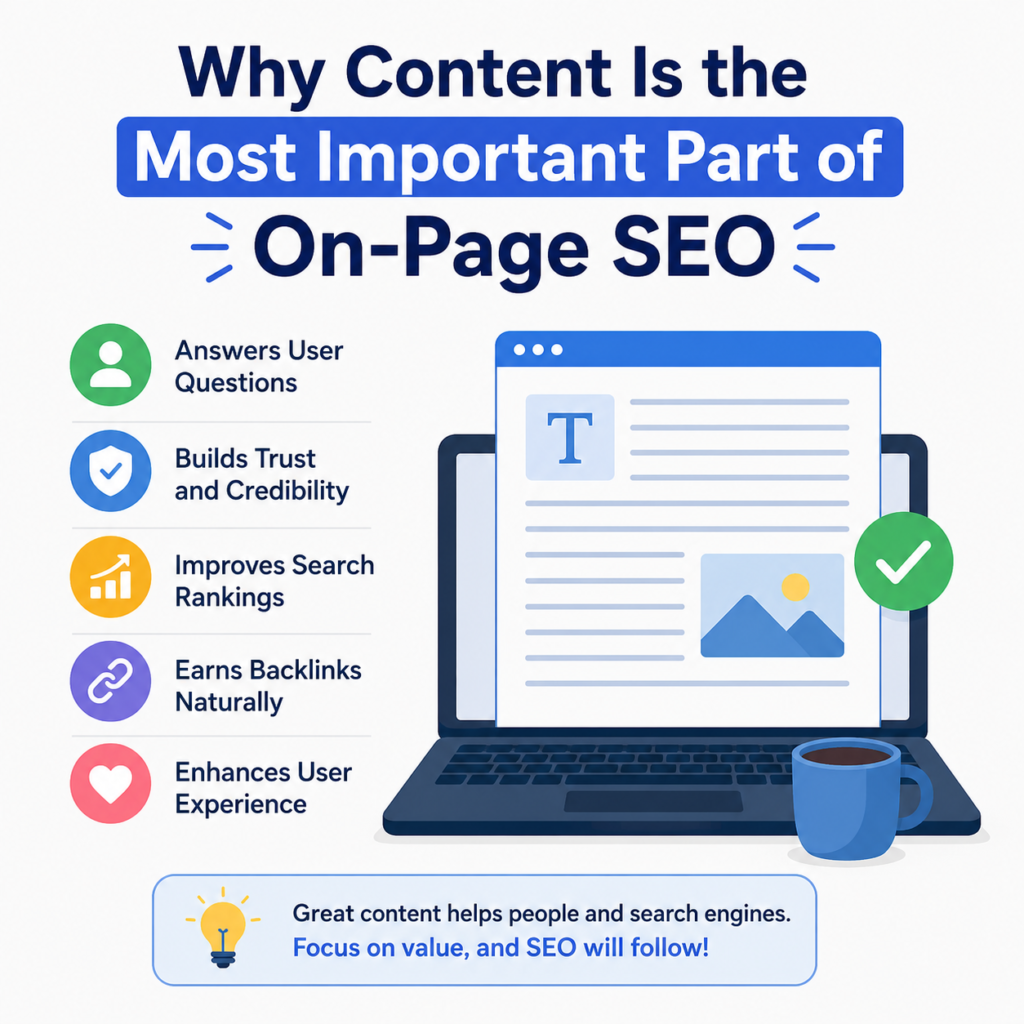
Good content helps you:
- Build trust
- Increase website traffic
- Improve user experience
- Get more shares
- Earn backlinks naturally
- Improve search rankings
Without quality content, even the best SEO techniques will struggle to bring long-term success.
Google Wants Helpful Content
Google’s main goal is very simple.
It wants users to find the best answer to their questions.
Imagine someone searches for “How to lose weight naturally.”
Google will not rank a page just because it has the keyword many times. Instead, Google looks for content that genuinely helps users.
The content should:
- Answer the user’s question
- Be easy to understand
- Be accurate
- Provide useful information
- Offer a good user experience
This is why content quality matters more than keyword stuffing.
What Is E-E-A-T?
One of the most important concepts in modern SEO is E-E-A-T.
E-E-A-T stands for:
Experience
Experience means the writer has real-life knowledge about the topic.
For example, if someone writes about weight loss after personally following a fitness routine, their experience adds value.
Google likes content written by people who have actually used, tested, or experienced something.
Expertise
Expertise means having knowledge and understanding of a topic.
For example, a fitness trainer writing about exercise techniques shows expertise.
The more knowledgeable your content is, the better it appears to users and search engines.
Authoritativeness
Authoritativeness means being recognized as a trusted source.
Websites that regularly publish quality content often become authorities in their niche.
People trust them because they consistently provide valuable information.
Trustworthiness
Trustworthiness is one of the most important factors.
Your content should be:
- Honest
- Accurate
- Transparent
- Safe for users
If people trust your website, Google is more likely to trust it too.
Why E-E-A-T Is Important for Content
E-E-A-T helps Google determine whether your content deserves to rank.
Imagine there are two articles on the same topic.
The first article contains outdated information and no real experience.
The second article contains personal experience, expert knowledge, accurate facts, and trustworthy information.
Google will usually prefer the second article because it provides more value to users.
This is why website owners should focus on creating content that demonstrates experience,
expertise, authority, and trust.
Why Content Should Always Be Checked Before Publishing
Many website owners write content and publish it immediately without reviewing it.
This can be a big mistake.
Before publishing any content, always check:
Grammar and Spelling
Small mistakes can make your website look less professional.
Readers may lose trust if they see too many errors.
Accuracy
Always verify facts, statistics, and information.
Wrong information can harm your website’s reputation.
Readability
Content should be simple and easy to understand.
Avoid using difficult words when simple words can explain the same thing.
User Intent
Ask yourself:
“Does this content answer the user’s question?”
If the answer is yes, then you are moving in the right direction.
Originality
Avoid copying content from other websites.
Google prefers original and unique content.
Why Thin Content Can Hurt Your Rankings
Thin content means content that provides little value.
Examples include:
- Very short articles
- Rewritten content
- Duplicate content
- Content filled with keywords but lacking useful information
Google wants users to get complete answers.
If your content is too short or unhelpful, it may struggle to rank.
Instead, focus on creating detailed and useful content that solves the reader’s problem.
The Latest Core Updates and Content Quality
Google regularly releases Core Updates.
These updates help Google improve search results and show better content to users.
In recent years, Google’s updates have focused heavily on content quality.
The main message from Google has been clear:
Create content for people, not just for search engines.
Websites that publish useful and trustworthy content often benefit from these updates.
On the other hand, websites that publish low-quality, copied, or AI-generated content without proper editing may see ranking drops.
What Google Looks for in Modern Content
Today’s Google algorithms look at several content-related factors.
Is the Content Helpful?
The content should solve a problem or answer a question.
Is the Content Original?
Google prefers unique information rather than copied content.
Does the Content Show Experience?
Real-life examples and personal insights make content more valuable.
Is the Information Trustworthy?
Users should feel confident that the information is accurate.
Does the Content Satisfy the Reader?
After reading the article, users should feel they got the answer they needed.
How to Create Better Content for SEO
Here are some simple tips:
Understand Your Audience
Know what your readers are searching for.
Write Naturally
Write as if you are talking to a friend.
Use Simple Language
Easy language improves readability.
Add Real Examples
Examples help readers understand concepts better.
Update Old Content
Refresh outdated information regularly.
Focus on Value
Always ask:
“How can I help the reader?”
If you focus on helping people, your SEO often improves naturally.
The Future of SEO Is Content Quality
SEO has changed a lot over the years.
Earlier, websites could rank by repeating keywords many times.
Today, Google is much smarter.
Modern SEO focuses on:
- User experience
- Helpful information
- Trustworthiness
- Expertise
- Real-life experience
This means content quality will continue to become even more important in the future.
Websites that genuinely help users will have the best chance of long-term success.
Conclusion
Content is the heart of on-page SEO. Titles, keywords, images, and meta descriptions are important, but they cannot replace valuable content.
Google’s recent core updates clearly show that helpful, trustworthy, and user-focused content is what matters most. By following E-E-A-T principles, checking your content before publishing, and focusing on solving readers’ problems, you can build a stronger website and improve your search rankings over time.
Instead of asking, “How can I rank higher on Google?” try asking, “How can I help my readers better?”
When you focus on helping people, good SEO often follows naturally.