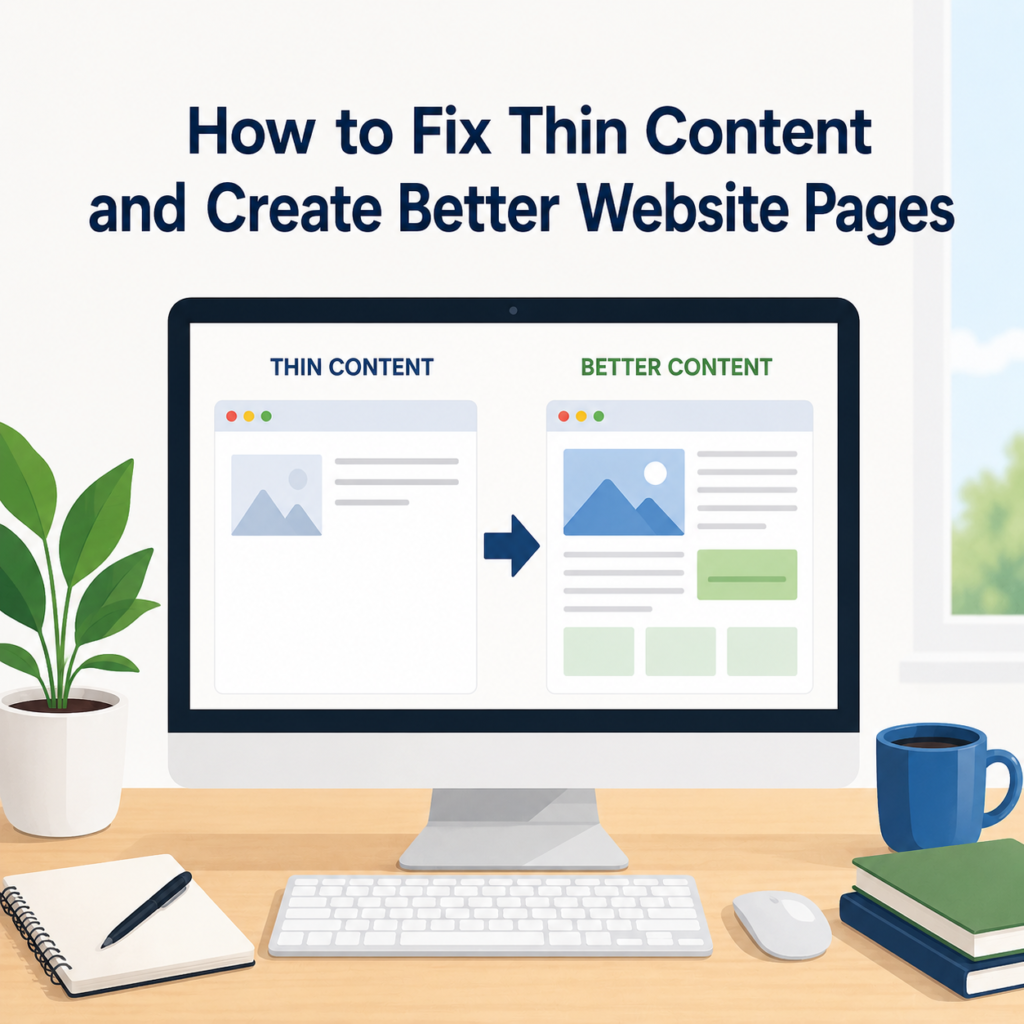
If you have a website, you probably want more people to visit it. One of the biggest things that can stop your website from growing is thin content.
Many website owners write short pages without giving enough information. Others copy content from different websites or repeat the same information on many pages. This can make it harder for search engines to understand the value of your website.
The good news is that fixing thin content is not difficult. With a little time and effort, you can improve your pages and make them more useful for your readers.
In this blog, we will understand what thin content is, why it matters, and how you can fix it using simple methods.
What Is Thin Content?
Thin content is content that provides very little value to readers.
A page may have only a few lines of text or may not answer the reader’s question properly. Sometimes the page exists only to target a keyword instead of helping visitors.
Thin content does not always mean a page is short. A short page can still be useful if it answers the user’s question clearly. A page becomes thin when it lacks helpful information.
Why Thin Content Is Bad for Your Website
People visit your website because they are looking for answers.
If they cannot find useful information, they may leave your website within a few seconds.
Search engines also try to show helpful pages to users. Pages with very little information often struggle to rank well because they do not fully meet the user’s needs.
Thin content can lead to:
- Lower search rankings
- Less website traffic
- Higher bounce rates
- Lower trust from visitors
- Fewer returning readers
Improving your content can help solve these problems over time.
Signs That Your Content Is Thin
Sometimes it is easy to spot thin content.
Look for pages that:
- Have very little information
- Repeat the same ideas again and again
- Do not answer the main question
- Have outdated information
- Contain copied content
- Have no images or examples
- Do not help the reader solve a problem
If your page has several of these issues, it is time to improve it.
Review Your Existing Pages
Before writing new content, review the pages that are already on your website.
Read each page as if you are a visitor.
Ask yourself:
- Does this page answer the question completely?
- Would I find this information useful?
- Is anything missing?
- Can I explain the topic better?
These simple questions will help you identify pages that need improvement.
Add More Helpful Information
One of the easiest ways to fix thin content is by adding more useful details.
Instead of writing only a few sentences, explain the topic properly.
Think about the questions readers may have and answer them in simple language.
For example, if you are writing about fitness, do not only explain what fitness is.
You can also explain:
- Why fitness is important
- Different types of fitness
- Common mistakes
- Simple daily habits
- Benefits for beginners
Adding helpful information makes your page more valuable.
Write in Simple Language
Many people think difficult words make content look professional.
In reality, simple language is much easier to understand.
Write as if you are talking to a friend.
Short sentences and easy words help readers stay interested until the end.
Simple writing also makes your website more welcoming for all types of visitors.
Add Real Examples
Examples make your content easier to understand.
Instead of only explaining an idea, show how it works in real life.
Readers remember examples better than long explanations.
Simple examples also make your content feel more natural.
Check for Duplicate Content
Duplicate content means the same or very similar content appears on multiple pages.
This can confuse both readers and search engines.
You should regularly check your website for duplicate content using plagiarism tools or SEO tools.
If you find duplicate content:
- Rewrite the content in your own words.
- Combine similar pages if they cover the same topic.
- Remove unnecessary repeated text.
- Make every page unique and useful.
Unique content gives your website a stronger identity and helps search engines understand the purpose of each page.
Update Old Information
Information changes over time.
Old statistics, outdated examples, and expired information should be replaced with newer details whenever possible.
Fresh content is more useful for readers and shows that your website is regularly maintained.
Improve Your Headings
Good headings help readers quickly understand your content.
Instead of using confusing headings, write clear and simple ones.
Each heading should explain what the next section is about.
This improves both readability and SEO.
Add Internal Links
Connect your blog posts with other related pages on your website.
For example, if you have another article about SEO, link to it naturally within your content.
Internal links help readers discover more information and spend more time on your website.
They also help search engines understand the structure of your website.
Use Good Images
Images make your content more attractive.
Choose clear and relevant images that support your topic.
Avoid adding random pictures that do not help the reader.
Simple visuals can improve the overall reading experience.
Remove Unnecessary Content
Sometimes pages become long because of repeated information.
Read your content carefully and remove anything that does not add value.
Every paragraph should have a purpose.
Quality is always more important than adding extra words.
Make Your Content Easy to Read
Readers usually scan a page before reading it.
Help them by making your content simple to follow.
You can do this by:
- Writing short paragraphs
- Using clear headings
- Keeping sentences simple
- Avoiding difficult words
- Explaining one idea at a time
Easy-to-read content keeps visitors engaged.
Use SEO and Plagiarism Tools
You do not have to find every problem manually.
Many SEO tools can help you identify thin pages, duplicate content, missing headings, broken links, and other issues.
Plagiarism checkers can also help you make sure your content is original.
Using these tools regularly helps keep your website healthy and improves the quality of your pages.
Keep Updating Your Pages
Creating good content is not a one-time task.
Review your important pages every few months.
Add new information, update examples, fix broken links, and improve explanations whenever needed.
Small updates over time can make a big difference.
Common Mistakes to Avoid
When improving your content, avoid these common mistakes:
- Copying content from other websites
- Writing only for search engines
- Repeating the same information
- Using difficult language
- Ignoring outdated information
- Publishing pages with very little value
- Forgetting to check for duplicate content
Focusing on your readers first will help you avoid most of these problems.
Final Thoughts
Thin content can stop your website from reaching its full potential, but it can be improved with simple changes. Instead of creating many pages with very little information, focus on building pages that truly help your readers.
Take time to review your existing content, add useful information, remove duplicate content, update old details, and write in simple language that everyone can understand.
You should also check your website regularly using plagiarism and SEO tools. These tools can help you find duplicate or thin content before it affects your rankings.
Remember, a great website is not the one with the most pages. It is the one that gives visitors clear, useful, and original information.
When every page provides real value, both your readers and search engines will appreciate your website, and your chances of improving your SEO will continue to grow over time.