If you have ever started writing a blog, one question probably came to your mind: How long should my blog be? Some people say 500 words are enough, while others believe every blog should have more than 2,000 words. This often confuses beginners.
The truth is that there is no fixed number of words that guarantees a high ranking on Google. A short blog can rank well if it answers the reader’s question clearly. At the same time, a long blog may not perform well if it contains unnecessary information.
The ideal content length depends on your topic, your audience, and what people are searching for. In this blog, we will understand what blog content length really means, why it matters, and how you can choose the right length for your articles.
What Is Content Length in a Blog?
Content length simply means the total number of words in your blog post. For example:
- A 500-word article is considered a short blog.
- A 1,000-word article is a medium-length blog.
- A 2,000-word or longer article is a detailed blog.
However, the number of words alone does not decide the quality of your content. A blog should be long enough to explain the topic properly without making readers feel bored.
Does Blog Content Length Really Matter?
Yes, content length does matter, but only when it improves the reader’s experience.
Google wants to show pages that give useful and complete answers. If your topic needs only 700 words, there is no need to stretch it to 2,000 words. On the other hand, if the topic is detailed, writing only 400 words may leave important questions unanswered.
The goal is to satisfy the reader, not just reach a specific word count.
What Is the Ideal Content Length?
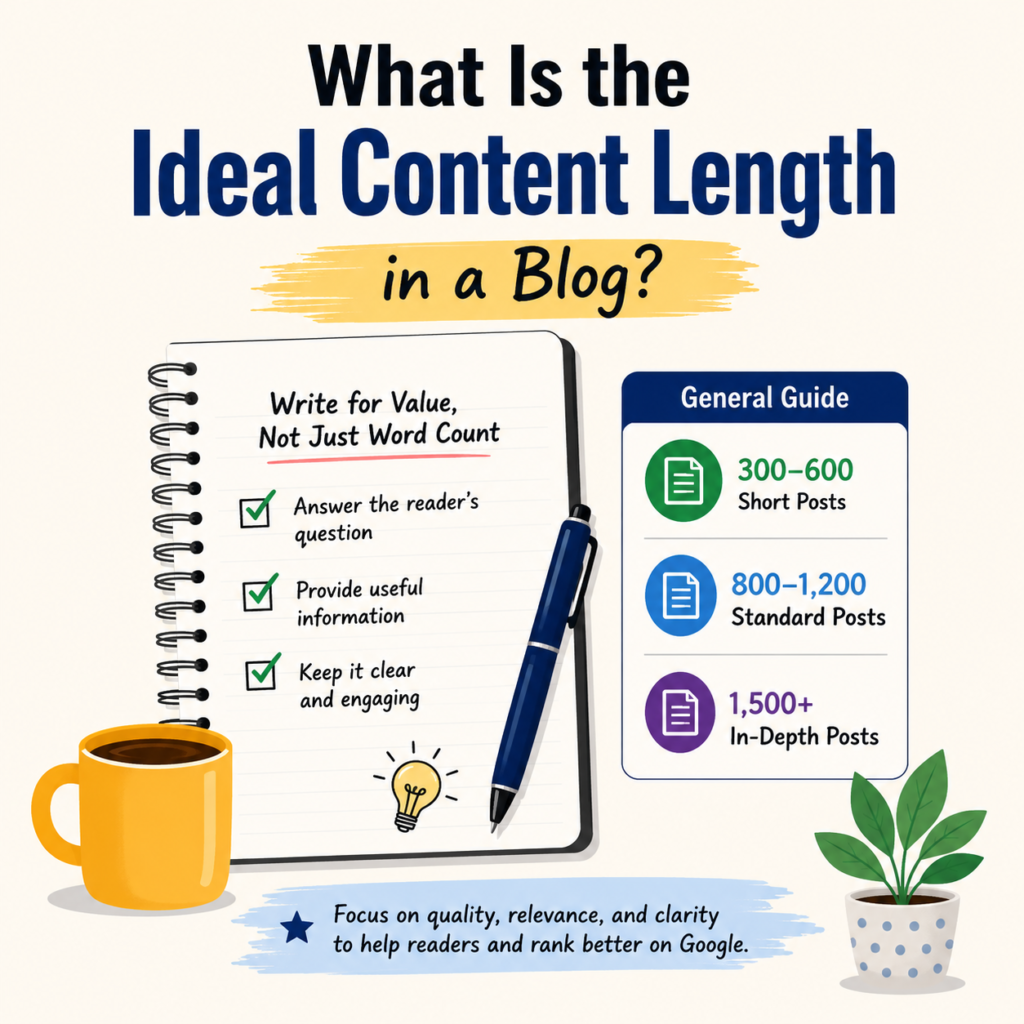
There is no perfect number for every blog, but these general ranges can help.
300–600 Words
This length is good for:
- Company updates
- Small announcements
- Simple news articles
- Short informational posts
These blogs are easy to read but may not be enough for competitive SEO topics.
800–1,200 Words
This is one of the most popular blog lengths.
It works well because it gives enough space to explain the topic while keeping the article easy to read. Many websites use this length for educational and informational blogs.
1,500–2,500 Words
Long-form blogs are suitable for detailed topics.
They allow you to answer more questions, include examples, explain important points, and cover the subject in depth. If readers are searching for complete information, longer articles often perform better.
Should Every Blog Be Long?
No.
Many people think longer blogs always rank higher. That is not true.
Imagine someone searches for “How to boil an egg.” They do not want to read 2,500 words before getting the answer.
Now imagine someone searches for “Complete Guide to SEO for Beginners.” In this case, a detailed blog is much more useful.
Always match your content length with the user’s search intent.
Quality Is More Important Than Word Count
One of the biggest mistakes bloggers make is writing extra paragraphs just to increase the word count.
Readers can easily notice when content is repeated or filled with unnecessary sentences.
Instead of asking:
“How can I write more words?”
Ask yourself:
“Have I answered all the important questions?”
Good content is always more valuable than long content filled with repeated ideas.
Factors That Decide the Ideal Blog Length
Several things help determine how long your blog should be.
1. Topic Difficulty
Simple topics usually need fewer words.
Complex topics require more explanation, examples, and details.
2. Search Intent
Understand what readers actually want.
If they need a quick answer, keep your blog short and clear.
If they want a complete guide, provide detailed information.
3. Competition
Search your keyword on Google.
Look at the top-ranking blogs.
If most successful articles are around 1,500 words, writing only 400 words may not cover the topic well enough.
Do not copy competitors. Instead, aim to create content that is more helpful and easier to understand.
4. Audience
Think about who is reading your blog.
Beginners usually prefer simple explanations.
Experts may expect detailed information with examples.
Write according to your readers’ needs.
How to Make a Long Blog Interesting
A long blog does not have to feel boring.
Here are a few simple ways to keep readers engaged:
- Use short paragraphs.
- Write clear headings.
- Explain ideas in simple language.
- Add real-life examples.
- Avoid repeating the same point.
- Use bullet points where needed.
- Keep sentences short and easy to understand.
These small changes make your content easier to read.
Common Mistakes to Avoid
Many bloggers make these mistakes while deciding content length:
- Writing only to reach a word count.
- Adding unnecessary information.
- Ignoring what readers actually want.
- Using difficult words that confuse readers.
- Repeating the same ideas again and again.
- Forgetting to update older blogs with new information.
Avoiding these mistakes will improve both user experience and SEO.
Does Google Prefer Long Blogs?
Google does not rank pages simply because they have more words.
Google prefers content that is:
- Helpful
- Accurate
- Easy to understand
- Well-organized
- Relevant to the search query
Sometimes a 700-word blog can rank above a 2,500-word article if it answers the user’s question better.
So, focus on creating useful content instead of chasing a specific word count.
Tips to Choose the Right Content Length
Before publishing your blog, ask yourself these questions:
- Have I answered the main question?
- Is any important information missing?
- Have I explained everything clearly?
- Is the content easy to read?
- Have I removed unnecessary sentences?
- Will readers leave satisfied after reading this blog?
If your answer is “yes,” your content length is probably just right.
Final Thoughts
There is no universal answer to the ideal content length in a blog. Some topics need only a few hundred words, while others require detailed explanations.
Instead of focusing only on word count, focus on creating content that is useful, easy to read, and answers the reader’s questions completely. A blog should never be longer than necessary, but it should never be too short to leave readers confused.
The best blog is not the one with the highest number of words. It is the one that provides real value, solves the reader’s problem, and keeps them engaged from beginning to end.
When you consistently write helpful, well-structured, and easy-to-understand content, both your readers and search engines are more likely to appreciate your work.