If you are new to the gym, you may hear many short words that you don’t understand. Trainers and gym-goers often use these short forms while talking about exercises and workouts.
One common term you may hear is DL.
So, what does DL mean in the gym?
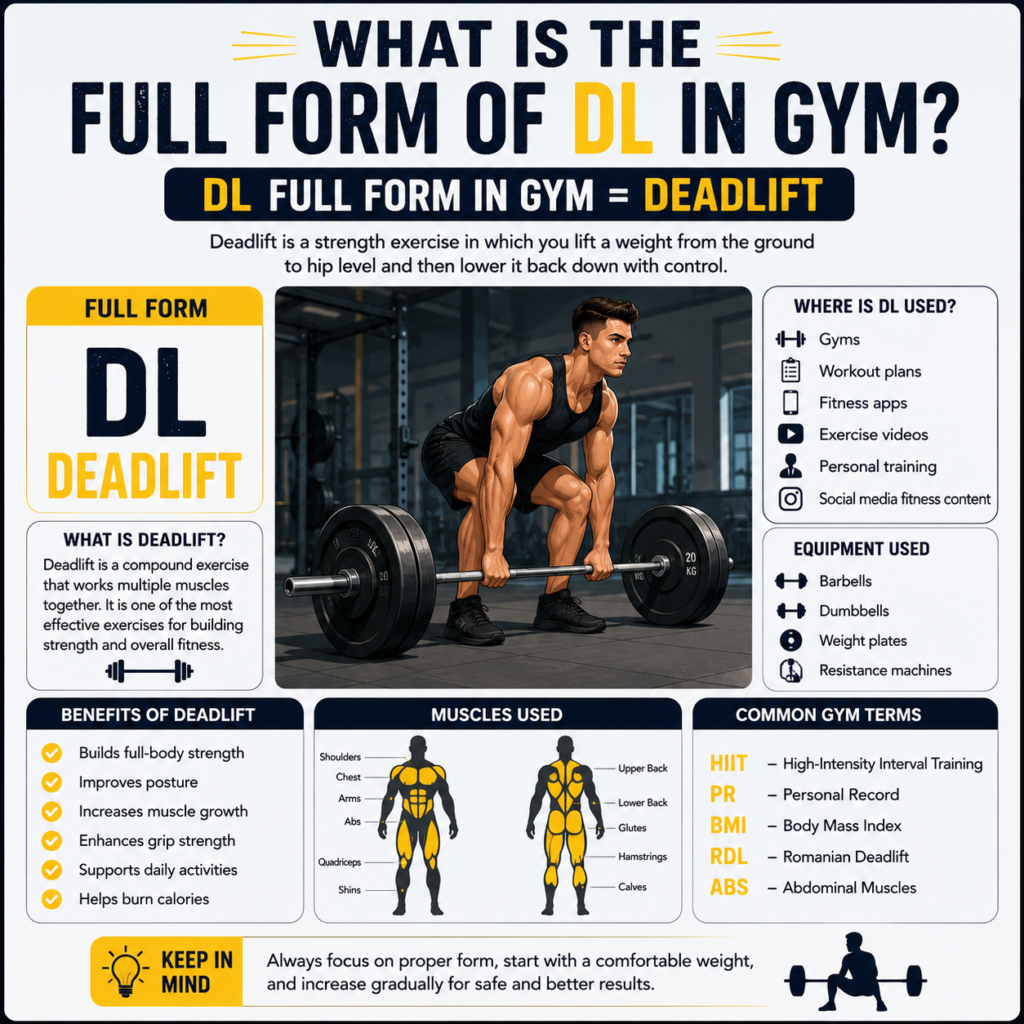
The answer is simple: DL stands for Deadlift.
A deadlift is a popular strength-training exercise where you lift a weight from the floor and stand up while holding it. It is a common exercise in many gym and strength-training workouts.
Let’s understand DL and deadlifts in simple language.
What Is the Full Form of DL in Gym?
The full form of DL in gym is Deadlift.
A deadlift is an exercise that starts with a weight on the floor. You hold the weight, lift it from the ground, and stand up in a controlled way.
Deadlifts are usually done with a barbell, but they can also be done with dumbbells or other types of weights.
In Simple Words
DL = Deadlift
A deadlift simply means lifting a weight from the ground and standing up with it while keeping proper form.
Why Is It Called a Deadlift?
The name may sound a little strange, but it is actually easy to understand.
The word “dead” refers to the weight being still or resting on the floor before you lift it.
The word “lift” means picking the weight up.
So, deadlift means lifting a weight that is resting on the floor.
What Muscles Does a Deadlift Work?
Deadlifts are a compound exercise, which means they work several muscles at the same time.
Depending on the type of deadlift and how you perform it, it can work your:
- Back muscles
- Glutes
- Hamstrings
- Legs
- Core
- Lower back
- Forearms and grip
This is one reason deadlifts are popular in strength-training workouts.
Why Do People Do Deadlifts?
People include deadlifts in their workouts for different reasons.
Deadlifts can help:
- Build overall strength
- Strengthen the legs and hips
- Work the back and core
- Improve grip strength
- Support better lifting ability
- Build muscle when included in a proper training program
However, doing the exercise with the correct form is very important.
What Equipment Is Used for a Deadlift?
A traditional deadlift is usually done with a barbell and weight plates.
You may also see other versions using:
- Dumbbells
- Kettlebells
- Trap bars
- Resistance bands
- Other gym equipment
The equipment can change depending on the type of deadlift and the person’s workout plan.
How Is a Basic Deadlift Done?
If you are a beginner, it is better to learn the movement with light weight first.
A basic deadlift generally looks like this:
- Stand with your feet about hip-width apart.
- Place the weight in front of you.
- To attain the weight, bend at the knees and hips.
- Hold the weight firmly.
- Keep your back in a stable position.
- Push through your feet and lift the weight.
- Stand up tall without leaning backward.
- Return the weight to the floor gradually.
If you are new to deadlifts, ask a qualified trainer to show you the correct technique before using heavy weights.
Why Is Proper Form Important?
Deadlifts use several muscles at the same time, so proper form is important.
Using poor form or lifting more weight than you can safely control can increase your risk of injury.
As a beginner, don’t worry about lifting very heavy weights. Focus on learning the movement correctly first.
You can slowly increase the weight as you become stronger and more comfortable with the exercise.
What Is the Difference Between DL and RDL?
You may also hear another gym term called RDL.
RDL stands for Romanian Deadlift.
Both DL and RDL are deadlift exercises, but they are performed differently.
A traditional deadlift starts with the weight on the floor. An RDL usually starts from a standing position, and the weight is lowered while pushing the hips backward.
RDLs mainly focus on the hamstrings and glutes, while traditional deadlifts involve several muscle groups.
Where Is DL Used?
You can see DL in many places, such as:
- Gym workout plans
- Fitness apps
- Training schedules
- Exercise programs
- Gym talks or conversations
- Fitness videos
- Social media posts
For example, a workout plan may show:
DL – 3 sets × 8 reps
This means you have to do deadlifts for 3 sets of 8 times each.
Common Examples of DL in the Gym
You may hear people say things like:
- “I am doing DL today.”
- “My DL weight has increased.”
- “How many DL sets are you doing?”
- “I need to improve my DL form.”
- “DL is part of my strength workout.”
In all these examples, DL means deadlift.
Is Deadlift Only for Advanced Gym-Goers?
No. Beginners can also learn deadlifts.
However, beginners should start with a light weight and focus on learning the correct movement.
You can even practice the movement without weights first. Once you understand the basic technique, you can slowly add weight.
There is no need to start with a heavy barbell just because you see experienced people doing it.
Different Types of Deadlifts
There is more than one type of deadlift. Some common variations include:
Conventional Deadlift
This is the traditional form of deadlift. It is usually performed with a barbell and works several muscles throughout the body.
Romanian Deadlift (RDL)
This variation focuses more on the glutes and hamstrings. It is commonly included in leg and lower-body workouts.
Sumo Deadlift
In a sumo deadlift, the feet are placed wider apart and the hands are positioned inside the legs. It has a different body position from a conventional deadlift.
Dumbbell Deadlift
Instead of using a barbell, you use dumbbells. This can be a simple option for beginners or people who prefer dumbbell training.
Common Gym Short Forms You Should Know
DL is just one of many short forms used in the fitness world.
Here are a few other common ones:
- DL = Deadlift
- RDL = Romanian Deadlift
- PR = Personal Record
- HIIT = High-Intensity Interval Training
- PB = Personal Best
- Reps = Repetitions
- Sets = A group of repetitions
- RM = Repetition Maximum
It may be simpler to comprehend exercise regimens and gym discussions if you are familiar with these words.
DL vs. Squat
Both deadlifts and squats are popular strength exercises, but they are different.
A squat mainly involves lowering and raising your body by bending your knees and hips.
A deadlift involves picking a weight up from the floor and standing with it.
Both exercises can work the legs and glutes, but they use different movements and place different demands on your body.
How Many Deadlifts Should Beginners Do?
There is no single number that works for everyone.
The number of sets and repetitions depends on your fitness level, workout plan, goals, and the type of deadlift you are doing.
If you are a beginner, start with a manageable weight and focus on your form. A trainer can help you choose the right number of sets and repetitions for your workout.
Common Mistakes Beginners Should Avoid
When learning deadlifts, aim to stay away from these typical blunders:
Lifting Too Heavy
Don’t try to lift heavy weights just to impress others. Start with a weight you can control.
Rounding Your Back
Try to maintain a stable back position throughout the movement.
Moving Too Quickly
Deadlifts should be performed in a controlled way. Don’t rush through the exercise.
Ignoring Your Form
Good form is more important than lifting a heavy weight.
Skipping Warm-Up
A light warm-up before strength training can help prepare your body for exercise.
Why Understanding Gym Terms Is Helpful
When you first join a gym, words like DL, RDL, PR, and HIIT can sound confusing.
Learning these simple terms can help you:
- Understand your workout plan
- Follow your trainer’s instructions
- Understand fitness videos
- Talk more easily with other gym-goers
- Feel more comfortable in the gym
You don’t need to know every fitness term on your first day. You can learn them slowly as you continue your fitness journey.
Final Thoughts
The full form of DL in gym is Deadlift.
A deadlift is a strength-training exercise where you lift a weight from the floor and stand up with it. It works several muscles, including the legs, glutes, back, core, and grip.
If you are a beginner, focus on learning the correct technique instead of trying to lift heavy weights. Start slowly, use manageable weight, and ask a qualified trainer for help if you are unsure about your form.
So, the next time you see “DL” in a workout plan or hear someone mention it at the gym, you’ll know that they are talking about Deadlift.