
Simple Difference Between Aerobic and Anaerobic Activities
 Shruti Thakral
May 21, 2026
Think about two people working out.
One is walking briskly on a treadmill for 30 minutes. The other is lifting a heavy weight, putting it down, taking a short break, and doing another set.
Both are exercising. Both are making an effort. But their bodies aren’t working in quite the same way.
The treadmill workout mainly uses aerobic energy production, while heavy weight lifting relies more on anaerobic energy systems during those short, demanding efforts.
That’s the basic difference between aerobic and anaerobic activities. One is commonly linked with activities you can continue for a longer time, while the other is associated with short bursts of intense effort.
You don’t need a science degree to understand either one. Let’s look at what happens during these exercises, where they differ, and why a fitness routine can benefit from including both.
What Is Aerobic Exercise?
Aerobic exercise is the kind of physical activity that keeps you moving continuously. Your heart beats faster, your breathing increases, and your muscles use oxygen to help produce the energy they need.
You probably do some form of aerobic activity already. Walking to the market, cycling, swimming, or dancing can all count, depending on how hard and how long you do them.
Take brisk walking as an example. You aren’t stopping after every few steps. Your legs keep moving, your breathing becomes quicker, and your heart works harder to supply oxygen to your muscles.
That’s aerobic exercise in everyday life.
The word aerobic is connected to oxygen. During these activities, oxygen-based energy production plays a major role in helping your muscles keep working.
It doesn’t mean every aerobic workout must be slow or easy. Running can be aerobic too, depending on the pace and duration. The important point is that your body can sustain the activity by relying largely on its aerobic energy system.
Simple Meaning of Aerobic Exercise
In simple words, aerobic exercise is activity that uses oxygen-based energy production to support continuous movement.
People often call it cardio. The two terms are commonly used when discussing activities that raise your heart rate and improve cardiovascular endurance.
Examples of Aerobic Activities
You don’t have to look far for examples. Many everyday and recreational activities can be aerobic.
- Brisk walking
- Jogging
- Steady-paced running
- Cycling
- Swimming
- Dancing
- Zumba
- Stair climbing
- Rowing
- Using an elliptical machine
The intensity matters. Walking slowly around your home is not the same as walking briskly for exercise. Similarly, a relaxed cycle ride and a fast cycling session place different demands on your body.
If you want some easy ideas to get started, read our guide to 10 aerobic activities for daily fitness.
Benefits of Aerobic Exercise
A good cardio session isn’t just about seeing a higher number on a treadmill or sweating through your T-shirt. Regular aerobic activity can support your fitness in several ways.
1. Supports Heart Health
Your heart has to pump more blood during physical activity because working muscles need more oxygen. Regular aerobic exercise can improve cardiovascular fitness and support healthy circulation.
Walking, cycling, swimming, and dancing are all ways to work on your cardiovascular endurance.
2. Helps With Weight Management
Walking, jogging, cycling, and swimming use energy. Including these activities in your routine can help support weight management.
But don’t treat cardio as a magic solution. Weight changes are affected by your eating habits, overall daily movement, sleep, and individual circumstances too.
A regular walk can be useful, but it doesn’t guarantee weight loss on its own.
3. Builds Stamina
Remember when a flight of stairs used to leave you catching your breath? With regular aerobic activity, your endurance can improve, making some everyday activities feel more manageable.
You might notice that you can walk for longer, cycle a little farther, or complete your usual workout without needing as many breaks.
These changes take time. They won’t happen after one session.
4. Supports Mental Well-Being
Exercise isn’t only about physical fitness. Physical activity can also help improve mood and reduce symptoms of anxiety and depression for many people.
A walk outdoors or a dance session can give you a break from sitting at a desk or thinking about the same tasks all day.
5. May Improve Sleep
Regular physical activity is associated with better sleep for many people. It can be a helpful part of a healthy daily routine, although it isn’t a guaranteed fix for sleep problems.
6. Supports Long-Term Health
Regular aerobic activity is associated with a lower risk of several health problems, including cardiovascular disease, high blood pressure, and type 2 diabetes.
It can also support weight management and general health. The benefits depend on your activity level, health, and other lifestyle factors.
What Is Anaerobic Exercise?
Now, let’s move to the other side of the comparison.
Imagine lifting a weight that feels challenging. You complete a few repetitions, put it down, and rest before trying again. Or picture a short sprint where you run as fast as you can, rather than trying to maintain that speed for half an hour.
These are examples of anaerobic exercise.
Anaerobic activities involve short periods of hard effort. Your muscles need energy quickly, so your body relies more heavily on energy systems that can supply it rapidly without depending mainly on oxygen-based energy production.
This is why activities such as heavy lifting and sprinting are usually performed in short bursts, with rest or easier movement in between.
One common misunderstanding needs clearing up: anaerobic does not mean your body uses absolutely no oxygen. Your body still uses oxygen. The difference is that, during very intense efforts, energy systems that can provide energy quickly make a greater contribution.
Simple Meaning of Anaerobic Exercise
Anaerobic exercise is usually short, intense physical activity in which your muscles need energy quickly.
It often involves strength, speed, power, or explosive movements. Unlike steady cardio, you generally cannot maintain the same high effort for a long period.
Examples of Anaerobic Activities
Here are some familiar examples:
- Sprinting
- Heavy weight lifting
- Push-ups
- Pull-ups
- Jump squats
- Box jumps
- High-Intensity Interval Training (HIIT)
- Resistance band exercises
- Fast cycling sprints
- Explosive strength exercises
The exercise name alone doesn’t always tell you how intense the activity is. For example, a few slow, controlled push-ups may feel manageable. A fast set performed close to your limit can be much harder.
The effort, duration, and rest periods all affect how your body produces energy.
Benefits of Anaerobic Exercise
Aerobic exercise gets plenty of attention, but strength-focused activity deserves a place in your routine too.
Anaerobic training can help develop muscle strength, power, and the ability to handle demanding movements.
1. Builds Muscle
Weight lifting, squats, push-ups, and resistance band exercises challenge your muscles.
With suitable training, enough recovery, and proper nutrition, your muscles can become stronger and may increase in size.
You don’t necessarily need a gym to begin. Bodyweight exercises can provide a starting point.
2. Improves Strength
Stronger muscles are useful outside the gym too.
Think about carrying grocery bags, lifting a suitcase, moving a chair, or getting up from a low seat. These everyday movements all require muscular strength.
Regular resistance training can help you become better prepared for such tasks.
3. Supports Healthy Bones
Resistance and weight-bearing exercises place stress on your bones and muscles. When performed appropriately, they can help support bone health and maintain bone strength.
4. Develops Speed and Power
Some activities require you to produce force quickly. Sprinting, jumping, and explosive movements train this ability.
Speed and power are useful in sports and activities that involve quick movement, jumping, or changing direction.
5. Helps Maintain Muscle Mass
Muscle mass tends to decrease naturally as people get older. Regular strength training can help maintain muscle and support physical function.
This is one reason strength exercises are useful throughout adulthood, not just for people who want bigger muscles.
6. Supports Weight Management
Strength training uses energy during a workout. It can also help build or maintain muscle while you’re working towards a weight-management goal.
However, don’t believe every claim about strength training automatically burning more fat or dramatically increasing metabolism. Results depend on the type of training, your body, nutrition, and overall activity.
Main Difference Between Aerobic and Anaerobic Activities
So, what separates these two types of exercise?
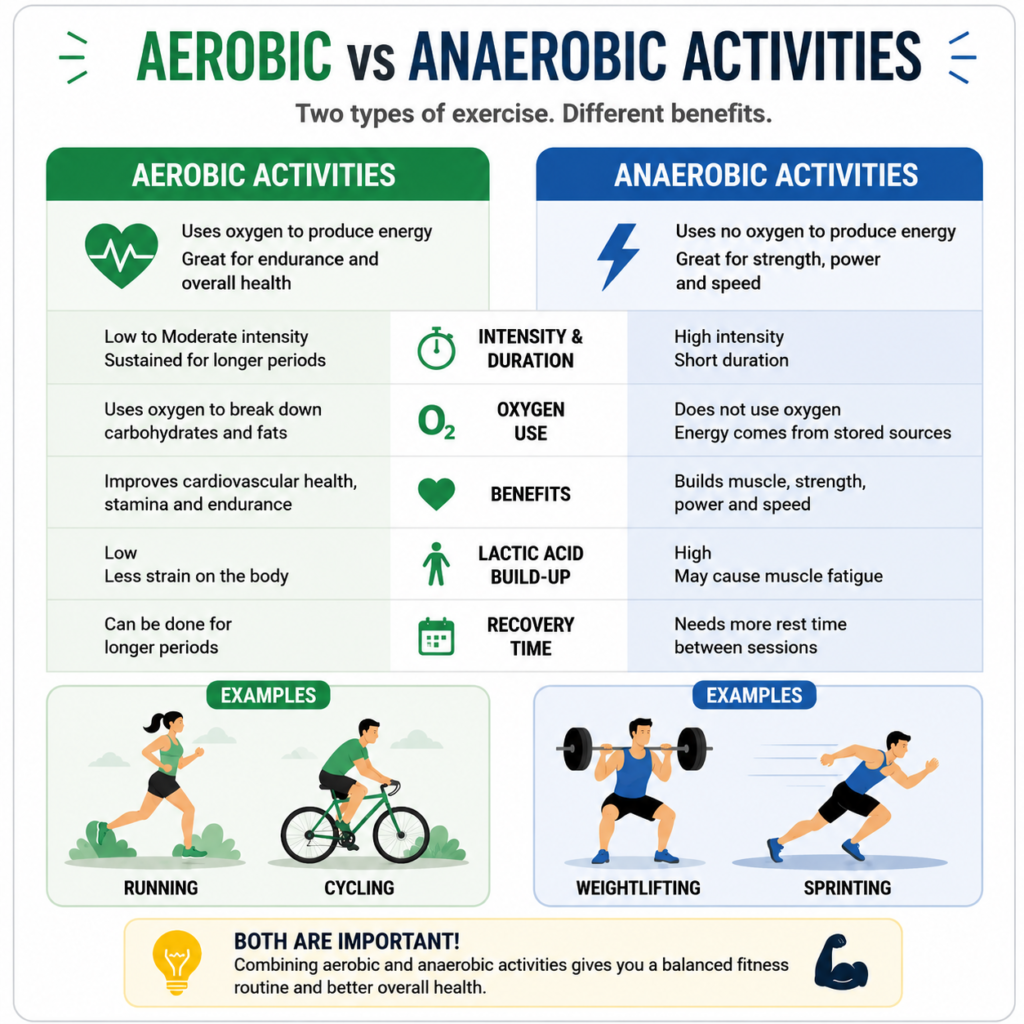
The main difference is how your body supplies energy during the activity. Aerobic exercise relies mainly on oxygen-based energy production, while short, intense anaerobic efforts rely more on energy systems that can supply energy quickly.
Here’s a side-by-side comparison:
| Comparison | Aerobic Exercise | Anaerobic Exercise |
|---|---|---|
| Energy production | Relies mainly on oxygen-based energy production | Relies more on energy systems that supply energy quickly |
| Typical effort | Steady movement or sustained effort | Short bursts of hard effort |
| Duration | Often continues for several minutes or longer | Usually performed in short bursts |
| Main fitness focus | Cardiovascular endurance and stamina | Strength, muscle, and power |
| Examples | Brisk walking, cycling, swimming | Heavy lifting, sprinting, jump squats |
| Rest | Can often continue at a steady pace | Usually includes rest between demanding efforts |
There is some overlap between the two. Your body uses several energy systems during exercise, and they don’t work like two separate switches. The intensity and duration determine which systems contribute more.
For everyday understanding, though, remember this: steady cycling is mainly aerobic, while a short, all-out sprint relies much more on anaerobic energy systems.
Neither type is automatically better. They simply train different abilities.
Which Exercise Is Better?
This depends on what you want from your workouts.
Someone preparing for a long-distance walk has different training needs from someone trying to improve their lifting strength. That’s why it helps to think about your own goal before choosing exercises.
Choose Aerobic Exercise If You Want To:
- Improve cardiovascular fitness.
- Build stamina and endurance.
- Stay active for longer periods.
- Add more movement to your day.
- Support weight management.
- Enjoy activities such as walking, cycling, or swimming.
For example, if you get tired during a longer walk, gradually increasing your walking time and pace may help build endurance.
Choose Anaerobic Exercise If You Want To:
- Build or maintain muscle.
- Improve muscular strength.
- Develop speed and power.
- Get better at strength-based activities.
- Make lifting and carrying everyday objects easier.
If your goal is to become stronger, exercises such as squats, push-ups, lunges, and weight training can be useful.
So, Which One Should You Pick?
You don’t have to pick a side.
A well-rounded fitness routine can include both aerobic and strength-focused exercise. Cardio works on endurance, while resistance training challenges your muscles.
How much of each you do depends on your goals, fitness level, health, and recovery needs.
Can You Combine Aerobic and Anaerobic Activities?
Yes. You can include both types of exercise in the same weekly routine. You don’t even have to do them in the same workout.
For example, you could go for a walk on Monday, do a strength session on Tuesday, and cycle on Wednesday.
Here are a few combinations:
- Walking and weight training: Walking works on cardiovascular endurance, while weight training challenges your muscles.
- Cycling and resistance exercises: Cycling provides aerobic activity, and resistance exercises help build strength.
- Running and bodyweight workouts: Running works on endurance, while squats and push-ups challenge your muscles.
- HIIT workouts: Depending on the exercises and intensity, HIIT can combine demanding cardiovascular movements with high-effort muscular work.
The important thing is not to turn every session into an exhausting workout. Plan your harder sessions sensibly and leave room for recovery.
Aerobic vs Anaerobic Exercise for Weight Loss
People often ask which type of exercise is better for losing weight. The answer isn’t as simple as choosing one over the other.
Both can contribute to weight management, but they do so in different ways.
Aerobic Exercise for Weight Loss
Activities such as brisk walking, jogging, cycling, and swimming use energy while you’re exercising.
How much energy you use depends on several things, including your body size, pace, duration, and effort.
For instance, a steady cycling session can add useful activity to your day without requiring a complicated workout.
Anaerobic Exercise for Weight Loss
Strength training and other intense activities also use energy.
Resistance training has another useful role: it can help build or maintain muscle while you’re managing your weight. This matters because weight loss can involve losing muscle as well as fat, particularly when strength training is missing from the routine.
What Is a Practical Approach?
Rather than treating cardio and strength training as competitors, include both if they suit your needs.
A practical routine can involve:
- Regular walking, cycling, swimming, or another cardio activity.
- Strength training that works the major muscle groups.
- Balanced meals that suit your needs.
- Enough sleep and recovery.
- A schedule you can actually maintain.
Weight loss varies from person to person. Neither aerobic nor anaerobic exercise guarantees a particular result.
Risks of Aerobic Exercise
Aerobic exercise is suitable for many people, but more exercise isn’t always better.
Doing too much too soon, using unsuitable footwear, or ignoring discomfort can cause problems.
Possible issues include:
- Muscle soreness or pain.
- Knee or other joint discomfort.
- Excessive tiredness.
- Dehydration.
- Overtraining when exercise and recovery aren’t balanced.
Safety Tips for Aerobic Workouts
A few sensible habits can make cardio sessions easier to manage:
- Start at a pace that feels comfortable.
- Warm up before walking, running, or cycling faster.
- Wear footwear suitable for the activity.
- Drink water, especially during longer sessions or in hot weather.
- Increase your exercise time and intensity gradually.
- Allow yourself to rest when needed.
If you have an injury, a health condition, or haven’t exercised for a long time, speak with a healthcare professional about which activities are suitable.
Risks of Anaerobic Exercise
Strength training and high-intensity movements place considerable demands on your muscles and joints. Problems can arise when you lift too much, rush through movements, or use poor technique.
Possible issues include:
- Muscle strains.
- Joint discomfort.
- Back injuries.
- Excessive fatigue.
- Overtraining when recovery is insufficient.
Safety Tips for Anaerobic Workouts
When doing strength or high-intensity exercises, keep these points in mind:
- Learn the correct technique before increasing the difficulty.
- Don’t begin with weights that are too heavy.
- Keep your movements controlled.
- Warm up before demanding sets.
- Give your muscles time to recover.
- Increase repetitions, resistance, or intensity gradually.
If you’re new to strength training, a qualified trainer can help you learn proper form and choose suitable exercises.
How Often Should You Do Aerobic Exercise?
You don’t have to do cardio every single day to make it count. What matters is your total activity across the week.
For adults, the World Health Organization recommends:
- 150–300 minutes of moderate-intensity aerobic activity each week, or
- 75–150 minutes of vigorous-intensity aerobic activity each week, or
- An equivalent combination of moderate and vigorous activity.
For example, 30 minutes of brisk walking on five days of the week adds up to 150 minutes.
You can also divide your activity into shorter sessions throughout the week. You don’t have to complete the whole amount in one or two long workouts.
If you’re currently inactive, don’t let these numbers put you off. Start with what you can manage and gradually build up.
How Often Should You Do Anaerobic Exercise?
Strength training should also have a place in an adult’s weekly routine.
The WHO recommends muscle-strengthening activities that involve all major muscle groups on at least two days each week.
Your exact schedule depends on the exercises you perform, how hard you train, and how much recovery you need.
Some people train different muscle groups on separate days. Others prefer full-body sessions. Both approaches can be used, depending on the person’s needs and training plan.
One thing is important: your muscles need time to recover after demanding sessions. Training the same muscles hard every day isn’t necessary.
Best Aerobic Exercises for Beginners
If you’re new to fitness, you don’t need to begin with running, fast cycling, or an intense cardio class.
Start with activities where you can control the pace.
- Walking: Begin at a comfortable pace and gradually walk faster or for longer.
- Light cycling: Use manageable resistance and pedal steadily.
- Slow jogging: If you’re comfortable with the impact, try short jogging periods between walking breaks.
- Basic dance workouts: Choose simple steps and music you enjoy.
- Swimming: If you already know how to swim, start with short sessions at a comfortable pace.
The idea is to improve your stamina without making every workout feel like a struggle.
Best Anaerobic Exercises for Beginners
You can start strength training without lifting heavy weights. Bodyweight movements and light resistance bands can help you learn the basics.
Here are some options:
- Bodyweight squats: Practise moving your hips back and standing up with control.
- Push-ups: Try wall push-ups or knee push-ups if standard push-ups are too difficult.
- Lunges: Start with a small range of movement and focus on balance.
- Resistance band exercises: Use a suitable band for controlled pulling and pressing movements.
- Light dumbbell exercises: Choose manageable weights and pay attention to your technique.
Start with a small number of repetitions. Increase the difficulty only when you can perform the movement comfortably and with good control.
Signs You May Benefit From More Aerobic Activity
These signs don’t mean you have a medical or fitness problem. They may simply give you a reason to look at how much you move during the week.
For example:
- You spend most of your day sitting.
- You get tired quickly during ordinary walking.
- Climbing stairs feels unusually difficult.
- You struggle to maintain a steady pace during physical activity.
- You rarely do activities that raise your heart rate.
If your ability to exercise changes suddenly or you become unusually breathless during ordinary activities, don’t assume you just need more cardio. Speak with a healthcare professional.
Signs You May Benefit From More Strength Training
You may want to add strength-focused exercise if:
- You want to build or maintain muscle.
- Lifting and carrying everyday objects feels difficult.
- You want to improve your muscular strength.
- Your current routine includes plenty of cardio but very little resistance exercise.
You don’t need heavy gym equipment to begin. Bodyweight movements and resistance bands can be a useful starting point.
Simple Weekly Workout Example
Still unsure how to fit both types of exercise into your week? Here’s one possible schedule.
| Day | Activity |
|---|---|
| Monday | Brisk walking – 30 minutes |
| Tuesday | Light full-body strength training |
| Wednesday | Cycling or comfortable jogging |
| Thursday | Rest or gentle stretching |
| Friday | Bodyweight workout |
| Saturday | Dancing or swimming |
| Sunday | Rest or easy movement |
This is only an example, not a schedule everyone needs to follow. Adjust the time and effort to your ability.
The walking, cycling, dancing, or swimming sessions provide aerobic activity. The strength sessions challenge your muscles. Rest days give you time to recover.
For more exercise ideas, take a look at our beginner workout routines at home.
Frequently Asked Questions
1. What is the main difference between aerobic and anaerobic exercise?
Aerobic exercise relies mainly on oxygen-based energy production and usually involves sustained movement. Anaerobic exercise involves short, harder efforts where the body relies more on energy systems that supply energy quickly.
2. Is walking aerobic or anaerobic?
Brisk walking is aerobic exercise because it keeps your body moving and raises your heart rate and breathing. A very slow walk may be light physical activity rather than moderate-intensity cardio.
3. Is weight lifting aerobic or anaerobic?
Traditional heavy weight lifting is generally considered anaerobic because it involves short periods of high muscular effort followed by rest. Lighter resistance exercises performed continuously may also raise your heart rate, so the intensity and workout structure matter.
4. Is running aerobic or anaerobic?
It depends on your speed and effort. Steady, longer-distance running is generally aerobic. Short, all-out sprints rely much more on anaerobic energy systems.
5. Can I do aerobic and anaerobic exercises on the same day?
Yes, provided the workout suits your fitness level and allows enough recovery. You could walk or cycle and then do a strength session. You can also perform them on separate days if that feels more manageable.
6. Which exercise is better for building muscle?
Strength-focused exercise, such as weight lifting, resistance band training, and bodyweight exercises, is generally better suited to building muscle than cardio alone.
7. Which exercise is better for improving stamina?
Aerobic activities such as brisk walking, cycling, swimming, and jogging are particularly useful for building cardiovascular endurance and stamina.
8. Do beginners need both aerobic and anaerobic exercise?
Including both is a good way to work on endurance and strength. Beginners can start with manageable cardio sessions and simple strength exercises, then gradually build their routine.
Final Thoughts
Aerobic and anaerobic activities aren’t two competing ways to exercise. They simply help you work on different parts of fitness.
A brisk walk or a steady cycle ride gives you a chance to work on endurance. Squats, push-ups, and weight training challenge your muscles. Both have a place in a balanced routine.
You don’t have to start with a packed weekly schedule. Try adding a few walks and two manageable strength sessions, then see how your body responds.
The best routine isn’t the one that looks impressive on someone else’s fitness page. It’s the one that fits your life, gives you room to recover, and is realistic enough to keep doing.


