
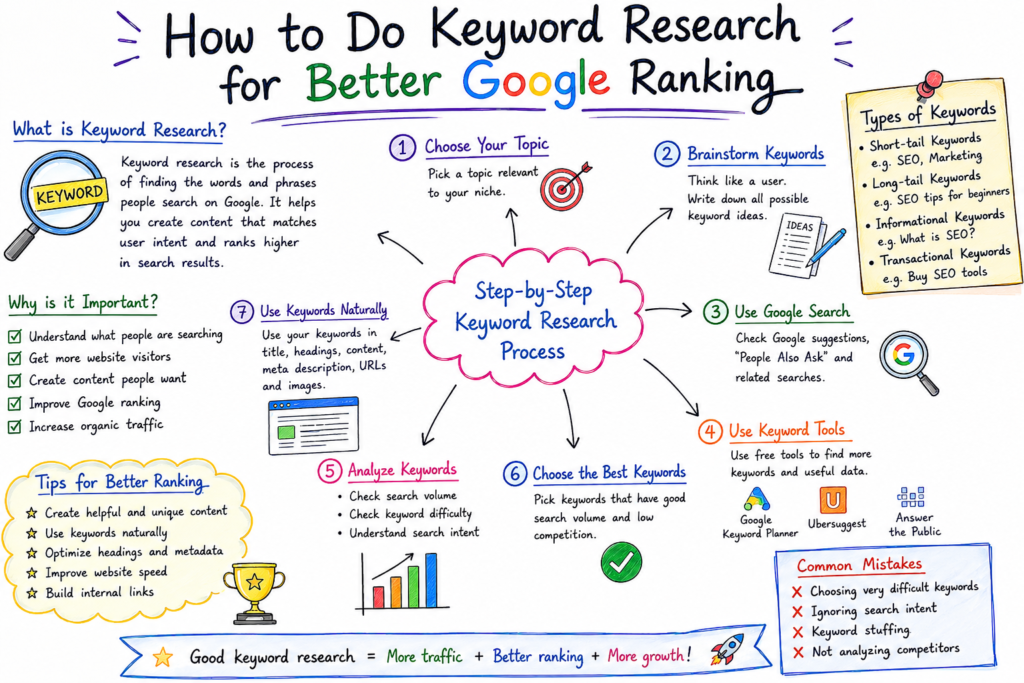
If you want your website or blog to appear on Google, keyword research is one of the most important things you need to learn. Many people write good content, but their website still does not rank because they are not using the right keywords.
Keyword research helps you understand what people are searching for on Google. When you use the right keywords in your content, Google can understand your website better and show it to more people.
The good thing is that keyword research is not difficult. You do not need to be an SEO expert to learn it. With a few simple steps, you can find good keywords and improve your Google ranking.
In this blog, you will learn what keyword research is, why it matters, and how to do keyword research in a simple and easy way.
What Is Keyword Research?
Keyword research means finding the words and phrases people type into Google while searching for information.
These words are called SEO keywords.
For example:
- “Best skincare tips”
- “How to lose weight naturally”
- “Easy SEO tips for beginners”
- “Best shampoo for dry hair”
These are all keywords because people search them on Google.
When you use these keywords in your content, your website has a better chance of appearing in search results.
Why Keyword Research Is Important
Many people write blogs without checking what users are searching for. Because of this, their content may not get traffic.
Keyword research helps you:
- Understand what people want
- Create useful content
- Get more website visitors
- Improve Google ranking
- Reach the right audience
- Increase organic traffic
Without keyword research, ranking on Google becomes much harder.
Types of SEO Keywords
There are different types of keywords in SEO. Understanding them can help you choose better keywords for your content.
Short-Tail Keywords
These are short keywords with one or two words.
Examples
- SEO
- Fitness tips
- Hair care
Problem with Short Keywords
They usually have high competition, which makes ranking difficult.
Long-Tail Keywords
These are longer and more specific keywords.
Examples
- Easy fitness tips for beginners
- Best hair care routine for dry hair
- How to improve SEO ranking fast
Benefits of Long-Tail Keywords
- Less competition
- Better ranking chances
- More targeted traffic
Long-tail keywords are usually better for beginners.
Informational Keywords
People use these keywords when they want information.
Examples
- What is SEO?
- How to lose weight?
- How to do keyword research?
These keywords work well for blog posts.
Transactional Keywords
These keywords are used when someone wants to buy something.
Examples
- Buy running shoes online
- Best laptop under 50000
- Cheap skincare products
These keywords are useful for business websites.
How Keyword Research Helps Google Ranking
Google wants to show users the most useful and relevant content.
When your content includes the right keywords, Google can better understand:
- What your content is about
- Who should see your content
- Which searches match your website
This increases your chance of ranking higher.
Step-by-Step Guide to Keyword Research
Step 1: Choose Your Topic
First, decide what topic you want to write about.
Examples of Topics
- Fitness
- Health
- SEO
- Hair care
- Digital marketing
- Weight loss
Your topic should match your website niche.
Step 2: Think Like a User
Ask yourself:
“What would people type into Google to find this information?”
This is the easiest way to start keyword research.
Example
If your topic is hair care, users may search:
- Hair care tips
- How to stop hair fall
- Best oil for hair growth
Write down all possible ideas.
Step 3: Use Google Search Suggestions
Google itself is a great keyword research tool.
When you type something into Google, it automatically shows search suggestions.
Example
If you type:
“SEO tips”
Google may show:
- SEO tips for beginners
- SEO tips for websites
- SEO tips to rank on Google
These suggestions are real searches from users.
Step 4: Check “People Also Ask”
Google also shows a section called “People Also Ask.”
This section gives extra keyword ideas and common questions people search.
Example Questions
- What is keyword research?
- Why are keywords important?
- How do beginners do SEO?
These questions can become blog headings too.
Step 5: Use Free Keyword Research Tools
There are many free tools that help you find keywords.
Popular Free SEO Tools
Google Keyword Planner
Helps find keyword ideas and search volume.
Ubersuggest
Shows keyword difficulty and related keywords.
Ahrefs Free Keyword Tool
Provides keyword suggestions.
AnswerThePublic
Shows questions people search online.
These tools make keyword research easier.
Step 6: Find Low-Competition Keywords
Beginners should focus on keywords with low competition.
These keywords are easier to rank for.
Example
Instead of:
“SEO”
Try:
“Easy SEO tips for beginners”
Long and specific keywords usually have lower competition.
Step 7: Check Search Volume
Search volume means how many people search for a keyword every month.
Why Search Volume Matters
- High search volume = More traffic potential
- Very low search volume = Less traffic
Try finding keywords with decent search volume and low competition.
Step 8: Understand Search Intent
Search intent means the reason behind a search.
You should understand what users actually want.
Types of Search Intent
Informational Intent
Users want information.
Example:
“How to do SEO”
Buying Intent
Users want to buy something.
Example:
“Best SEO tools to buy”
Your content should match the user’s intent.
Step 9: Use Keywords Naturally
Do not stuff keywords everywhere.
Google prefers natural content.
Best Places to Use Keywords
- Blog title
- Introduction
- Headings
- Meta description
- URL
- Image alt text
- Content naturally
Use keywords smoothly and naturally.
Step 10: Analyze Competitors
Search your keyword on Google and look at top-ranking websites.
Check These Things
- Their headings
- Content length
- Keyword usage
- Images
- Content quality
This helps you understand what works.
Common Keyword Research Mistakes
Choosing Very Difficult Keywords
High-competition keywords are hard to rank for.
Beginners should focus on easier keywords.
Ignoring User Intent
Even if a keyword has high traffic, it may not help if it does not match user needs.
Keyword Stuffing
Using the same keyword too many times looks unnatural.
Google may reduce your ranking.
Not Updating Keywords
Search trends change over time.
Always check for new keyword opportunities.
Best Tips for Better Google Ranking
Create Helpful Content
Google ranks useful content higher.
Always focus on helping readers.
Use Proper Headings
Organize your content using:
- H2 headings
- H3 headings
- H4 headings
Good structure improves readability and SEO.
Add Internal Links
Link your blogs to other related pages on your website.
This helps users and search engines.
Optimize Images
Use proper image names and alt text.
Example:
Instead of:
“IMG123”
Use:
“keyword-research-guide”
Improve Website Speed
A fast website improves user experience and ranking.
Write Longer Quality Content
Detailed and useful content often performs better on Google.
But quality is more important than word count.
Easy Keyword Research Example
Let’s say your topic is:
“Weight Loss”
Step-by-Step Example
Broad Keyword
- Weight loss
Better Keyword Ideas
- Easy weight loss tips
- Weight loss tips for beginners
- Healthy weight loss at home
- Best foods for weight loss
Final Keyword Choice
“Easy Weight Loss Tips for Beginners”
This keyword is more specific and easier to rank for.
How Often Should You Do Keyword Research?
Keyword research is not a one-time task.
You should do it regularly because:
- Trends change
- User searches change
- Competition changes
Checking keywords regularly helps keep your content updated.
Conclusion
Keyword research is one of the most important parts of SEO. It helps you understand what people are searching for and how you can create content that matches their needs.
You do not need expensive tools or expert knowledge to start keyword research. Simple methods like Google suggestions, free SEO tools, and understanding user intent can help you find great keywords.
Focus on low-competition and long-tail keywords, create helpful content, and use keywords naturally. Over time, these small SEO efforts can help improve your Google ranking and bring more traffic to your website.
Good keyword research is the first step toward successful SEO.